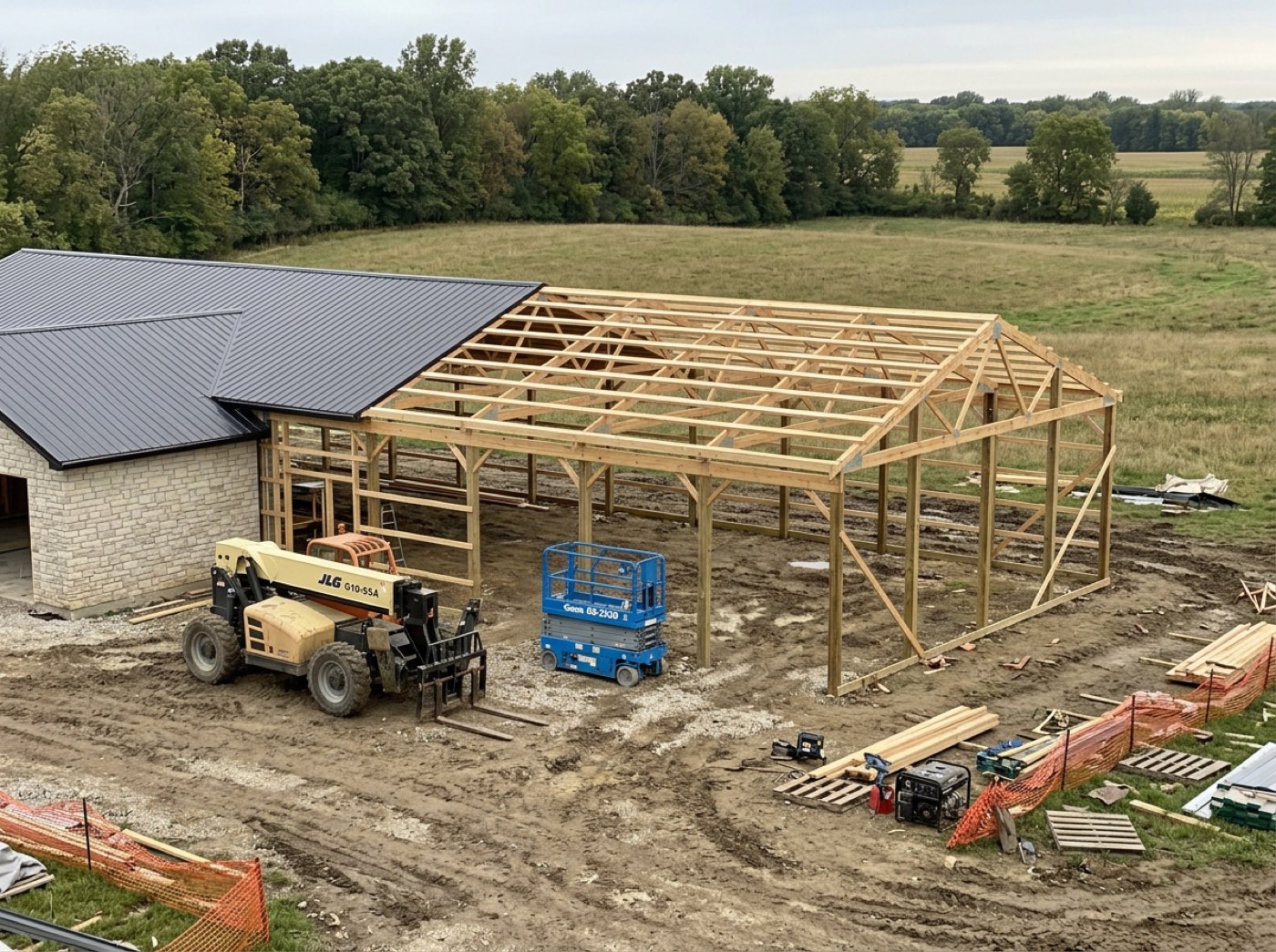
A man taps Clock In on his field link and taps out when he leaves. The hours are worked out from the two moments, not typed from memory. The job comes off the work he has accepted, and the stage is stamped onto the entry as he clocks in — so the hours land on Framing at the Wenger shop rather than on nothing in particular.
Also called: clock in clock out · crew timesheet · time tracking for crews · hours from the field
Hours become two timestamps instead of a Friday guess
Try itOne tap in, one tap out, and the hours are worked out from the two moments when the shift closes. The count runs on the button itself, to the second — ON THE CLOCK · 3h 12m 08s — and the time recorded is the time on his phone when he tapped. With no signal the tap is saved on the phone and sent later; once it reaches the office, a dead battery or a swapped phone does not lose the day. Everything else on that screen — how the link reaches his phone with no password, and what it does on one bar — is on the crew app.
Friday afternoon a man works backwards through four jobsites in his head, lands on a number, and that number is what you pay him.
Everything downstream was left alone on purpose — approvals, payroll and the job's costs read the same hours figure they always did, except now it comes off two recorded instants instead of a recollection. What a man writes down on Friday about last Tuesday is a guess, and you are the one paying it.
Every hour lands on a job and on a stage
The job comes off the crew's accepted work — one job needs no question, several show as cards, and a concrete crew swipes between its jobs — and the stage is stamped onto the entry as he clocks in. The result is not 40 hours this week. It is eight hours on Framing at the Wenger shop. That difference is what separates a payroll number from a job-cost number.
The shop lands eleven grand over on labour and nobody can say whether framing or the roof steel is where it went.
Asking a man to file his own hours against a stage guarantees the quickest option every time, so he is never asked — the job is the only question put to him, and only when his crew genuinely has more than one running.
You cannot clock into a job you have not accepted
Try itWhen the office puts a crew on a job and names who is going, each of those people accepts the job on his own phone, and only then is it somewhere he can clock in. With a new job still waiting, Clock In says Accept your new job first — it's under the buttons. The card he accepts, with the dates, the address and the plans, is part of the crew app; a subcontractor crew instead signs the acceptance contract.
A crew logs four days onto a build that was offered to them and quietly handed to somebody else, and the first anyone knows is a labour line on the wrong job.
An offered job showing up as somewhere to clock in would let hours pile onto work nobody agreed to take, and you would find out from a cost report. Accepting it on his own phone means he chose it, and nobody can say the job went to the wrong number.
The stage is stamped when he taps in, not when he taps out
The entry freezes the stage the job was on at that moment. If the office moves the build from Framing to Roof steel at two in the afternoon, the morning's hours stay on Framing, because that is the work that was being done. Which crew owns that stage was settled in the office, where each stage is given to a crew in the job's labour panel.
The schedule advances at lunchtime and eight hours of framing turn up on the roof steel line, where nobody ordered them.
Reading the stage at clock-out — or worse, at report time — makes yesterday's hours change meaning every time the schedule moves, and a labour number that shifts on its own is a number nobody defends in a meeting. The cost of freezing it is that you cannot re-cut history later. That is the trade, and it is worth making.
Location is stamped, and never enforced
Where he clocked in and where he clocked out are both recorded when the phone will give them up, the same way a jobsite photo carries its coordinates. A denied permission, a slow fix, or a steel building that swallows the signal simply means no pin — it never refuses a clock-in and nobody loses a day's pay to it. A hard fence blocks the man when the technology fails. This records the evidence and leaves the judgement with you.
Six weeks on, an hour gets questioned and all anyone has is two people's memory of where the truck was parked that morning.
Recording both ends means an odd one — a clock-in half a county from the site — stands out on its own, while every ordinary day passes with nobody asked to prove they were there. The trade is that a man who wanted to cheat it still can; what he cannot do is cheat it invisibly.
A double tap cannot become a double shift
Try itClocking in while already on the clock hands back the shift that exists rather than opening a second one, and clocking out with none open comes back as already done. On a bad connection people tap twice. Everything that adds hours up afterwards — the labour rollup included — is then arithmetic on shifts that cannot overlap.
One tap on a single bar of signal, nothing happens, he taps again — and a fortnight later payroll is sixteen hours heavy with nothing to say where they came from.
The second tap is not met with an error a man on a roof would have to interpret; he is handed back the shift he already has, so the screen tells him the truth and there is nothing left to reconcile. The database carries a standing index on open shifts per person, so the question am I on the clock is one lookup rather than a scan somebody could talk themselves out of trusting.
A leader can clock his own crew in, and the record says he did
From Today's Crew the leader taps Clock in beside a name. The worker is recorded as the worker; the leader is stamped as the man who entered it. The man who left his phone in the truck still gets his day, and if anyone argues about that entry later it is attributable to a name. Doing this for his own men is one of the things a crew leader is trusted with — the rest of that list, and everything deliberately left off it, is on roles and permissions.
A man leaves his phone charging in the truck at seven, and by the time anyone notices, his morning has to be reconstructed by two people who disagree about it.
The entry lands on whatever job the leader himself is clocked into, because a crew works one site at a time and he is standing on it — an exception that costs two taps is one that happens in here, rather than by text message where nothing is kept.
The leader sees who is actually on the clock this morning
Try itHis own crew as a list of names with two facts each: on the clock since when, or hours already closed out today. The names are the men the office put in that crew in crews management, and he sees nothing outside it — his own crew is the whole of what that link can read, with no setting anywhere that widens it, which is a harder wall than the crew visibility the office side gets on roles and permissions. Missing time gets fixed the same morning on site instead of turning up as a hole on payday.
The missing Tuesday surfaces on payday, in front of the man it costs, with nothing left to check it against.
Deliberately a roster and not a report — the leader gets the smallest thing that lets him correct this morning's mistake while it is still this morning's, which is the only point where a fix costs a conversation instead of trust.
The shift nobody closed raises an alarm, not a guess
Anyone left on the clock for twelve hours raises a never clocked out alert carrying the name, the job and the time he started — sent wherever the company's own notification rules point it, and once per shift so it stays worth reading. It deliberately does not close the shift. Writing in a knock-off time nobody chose would put an invented number onto someone's pay. A human sets the real time, and that correction carries their name.
Somebody drives home still clocked in on Thursday and the nineteen-hour day turns up when payroll is already running.
Twelve hours is counted from the clock-in itself rather than the crew's planned finish, so a four-in-the-morning start is not flagged for being early. Who hears it is a setting rather than a hard-coded chain — it goes to the owners and project managers unless the company points it at the leader standing on the same slab, who can settle it with one question to the man himself.
The worker can check his own week, split into approved and waiting
On the Crew door, under his own clock, is one big number for the week, then 24h approved · 8h waiting, then a tile for each day with its hours — green once approved, marked waiting until it is. Approved and waiting are never blended into one figure that implies you have agreed to something you have not — nothing he taps becomes a cost until somebody has looked at it, and that happens on the office side in the job's labour panel.
Every second Thursday somebody stands at your elbow asking what he is owed, and you put down what you were doing to go and count it for him.
He is reading the office's own entries rather than a copy of them, so payday starts from one sheet instead of two — and a man who can see a day missing from his own week chases it while the crew that worked it still remembers.
The hour arrives as the figure everything downstream already read
Hours is the same column approvals, payroll and the job's costs have always read — the punch clock changed where the number comes from, not what reads it. What lands here is a record of the work, not a wage: what a day is worth, and how a crew's surplus gets split by the hours in it, is set out in day rates with shared surplus. The hour stops here, and what it costs the job against what you quoted is worked out in estimate against actual.
Two hours columns, and by March the payroll report and the P&L disagree by a hundred and forty hours with nobody able to say which is the real one.
A second hours field would have meant touching every report that reads the first one, and every one of those is a place two numbers could quietly diverge. Deriving into the existing column costs you the ability to hold a typed figure and a punched figure side by side; the column says which one it is holding, and that was judged enough.
A typed number still exists, for people who are not on your clock
Try itA subcontractor's own men log hours or units by entering them on their portal, because they are not your employees and their phones are not on your clock. Your men punch; a sub's company reports. The entry says which it was — clocked by the man, entered by his leader, or submitted by a sub — so the office can tell those three apart without reading names.
A disputed Thursday, and nobody can say whether that eight hours came off a clock, off a leader's phone, or off a sub's own paperwork.
One universal hours form would have been less code, and it would have thrown away the single distinction that makes a labour dispute answerable. Keeping the source on every row costs a column and buys you an answer to where did this eight hours come from that nobody has to reconstruct.
- 1He taps Clock In. One job needs no question; several show as cards to pick from — a concrete crew swipes to the job instead.
- 2The button itself counts, to the second — ON THE CLOCK · 3h 12m 08s — and the time recorded is the moment he tapped, kept on the phone until there is a signal.
- 3He taps Clock Out, and the hours are worked out from the two moments.
- 4The entry carries the job, the stage and who entered it.
- 5It lands waiting for approval, in the same queue and the same job costs as every other hour.
Labour hours were a number somebody typed at the end of a day — or worse, the end of a week. A man on a roof does not stop to do that, so the number he eventually writes down is a guess, and you are paying it. Clocking in and out records two real instants and works the hours out from them. Everything downstream reads the same hours figure it always did, so approvals, payroll and the job's costs keep working exactly as before.
- Hours reconstructed from memory days later are guesses.
- Nobody could tell which stage a day's hours belonged to.
- Payroll arguments with no record to settle them.
Location stamped, never enforced
The phone is asked for a position and stops asking after a few seconds. No permission, a slow fix or a steel building simply means no pin. The office can look at the odd ones. The clock never refuses a man on location grounds.
Leader clocks a man in
Someone forgets. Someone's phone is dead. Someone doesn't carry one — and that man still worked. From Today's Crew the leader taps Clock in beside a name. The worker is recorded as the worker; the leader is stamped as the man who entered it.
Today's crew
For leaders only. Each name reads On the clock · 2h 40m, Done · 8h today, or Not clocked in, with a clock button beside anyone but himself. It is his own crew and nothing else.
One open shift per man
A man can only ever have one shift open. Tap Clock In twice and the second tap returns the shift that exists. Tap Clock Out with nothing open and it says already done rather than throwing up an error.
Shift that never ended
A man drives home still on the clock. After twelve hours the crew leader hears about it, and an owner after him. It fires once per shift, and it never invents a knock-off time.
This week, approved and waiting
The bottom of his screen shows the week's hours from Monday, with approved and waiting stated separately, then a day-by-day list naming the job and where each entry stands. He can spot his own missing day.