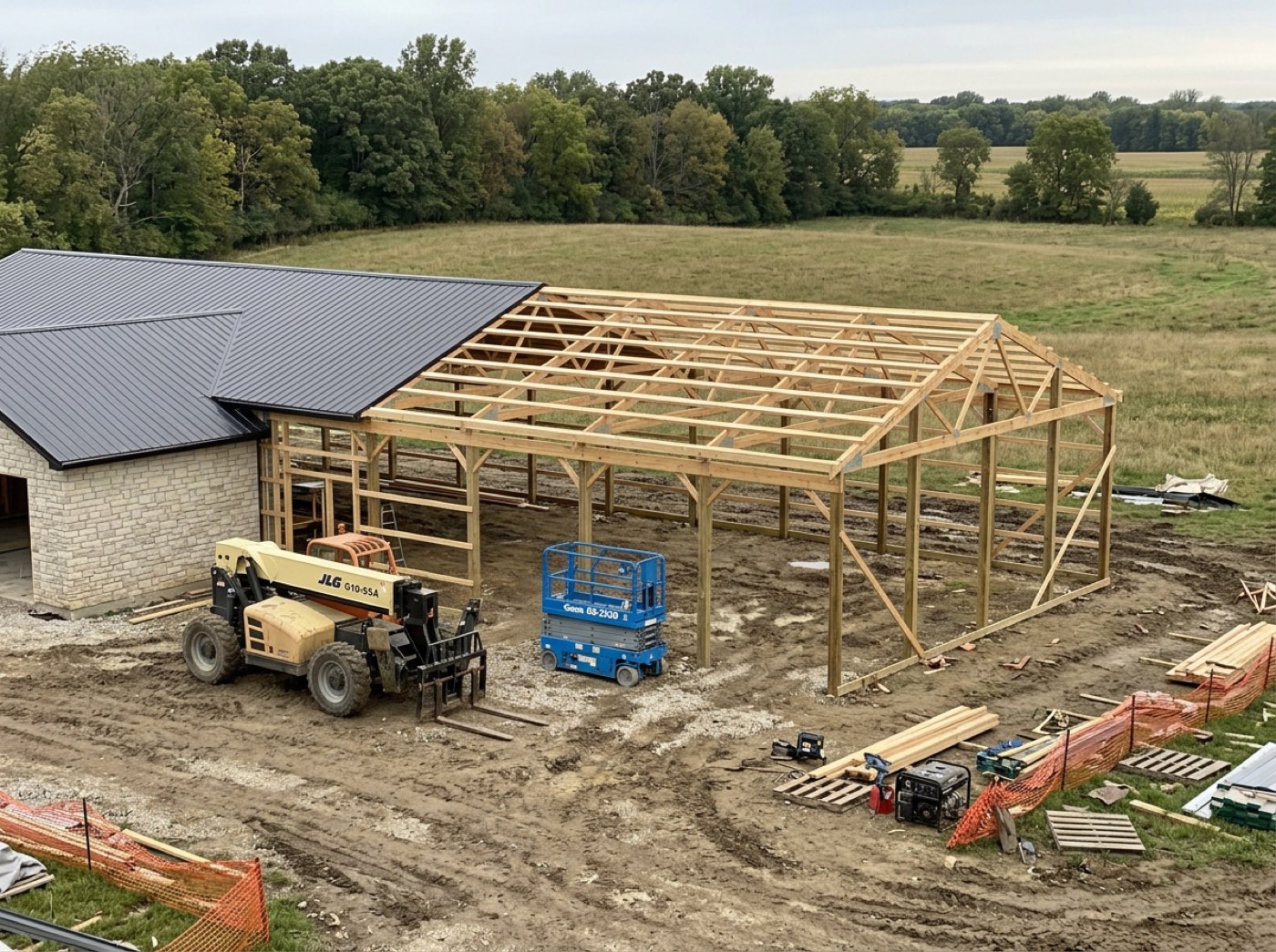
Five columns — Kickoff, Materials, Build, Wrap-Up, Complete. Each move is triggered by something real: starting the job, the materials invoice paid in full, the first build checkpoint ticked, the last build stage finishing, the final invoice paid. A card can never slide backwards. It is the operating system for post-frame and barndominium builders, so the board moves on the events a pole-barn job actually has — material payment in, materials ordered, delivered, final paid.
Also called: project pipeline · kickoff materials build wrapup complete · PM board · project stages on a board
Five columns, each reached by doing the work — not by dragging a card
Kickoff, Materials, Build, Wrap-Up, Complete. Starting the job puts the card on the board; the materials invoice paid in full moves it to Materials; the first build checkpoint ticked moves it to Build; the last build stage finishing moves it to Wrap-Up; the final invoice paid moves it to Complete. Nobody has to remember anything, which is why the board is still right on Friday. Every move writes a line you can read afterwards — "Material payment collected — invoice paid in full".
The board is right on Monday and wrong by Thursday, because moving cards is nobody's job and everybody's afterthought.
The owner can trust the board on a Friday afternoon without ringing anyone, because nobody had to remember to keep it current. A board that maintains itself is one the whole office actually reads.
A paid invoice moves the job, not a status somebody sets
The materials invoice paid in full is what puts a card in Materials; the final scheduled invoice paid in full is what marks the build Complete. The money and the board are reading the same record, so "are we still waiting on the deposit" is not a question for the office.
Materials get ordered on a payment someone thought had cleared, and the builder carries the supplier bill for a month.
The office stops fielding "has the material money come in?" because the card already says so. When the money and the board read the same record, the crew never orders steel on a deposit that never landed.
A card can never slide backwards
A repeated event does nothing, and no event can pull a card back to a column it has already left. A project stage always outranks a sales stage, so a late sales action cannot drag a live build back onto the sales board. Manual drags stay available as an override, and they are logged loudly.
Someone re-sends an old estimate and a job that is half framed reappears as a sales lead, confusing the rep and the crew at once.
The project manager can trust that a build in Wrap-Up is really in Wrap-Up — a late sales click can't drag it back onto the sales board. Fewer phantom moves means fewer "wait, where did that job go" mornings.
Material payment, ordered, delivered, final payment — badges on the card, not new columns
The finer facts ride on the card as time-stamped badges instead of turning into columns: Material payment ✓ or Awaiting material payment at Kickoff, Ordered ✓ / Order not sent and Delivered ✓ / Awaiting delivery in Materials, Final payment ✓ or Awaiting final payment in Wrap-Up. The board stays five wide and still tells you which jobs are waiting on material, and each badge records when the thing first happened — a mis-click can be taken back.
Every new status becomes another column until the board is too wide to read, and the job waiting on a delivery hides off the right edge.
The project manager sees what each job is waiting on in one glance across five columns, not a scroll across fifteen. A board people can read across is a board that catches the stuck job early.
Ticking "Order Placed" is what records the order, however you ordered it
Try itYou phone the supplier, you tick the Order Placed checkpoint you were going to tick anyway, and the card stamps the order as sent. There is no second screen to remember. And "delivered" is measured against that stage's real checkpoint list, so one box ticked cannot mark a whole delivery finished.
The order goes out by phone, nobody updates the board, and the crew lead arrives expecting material that was never confirmed.
The office ticks the box they were going to tick anyway, so the board stays true without a second screen to remember. Less double entry is fewer jobs that look ordered and aren't.
- 1Start the job and the card appears at Kickoff.
- 2Materials invoice paid in full moves it to Materials.
- 3First build checkpoint ticked moves it to Build.
- 4Last build stage finished moves it to Wrap-Up.
- 5Final invoice paid moves it to Complete.
- 6Every move writes a line you can read afterwards.
The project board was permanently empty. It listed jobs that had reached a project stage, and nothing in the system ever moved a job into one, so builders opened a board that had never held a single card. Cards appear off real events now — a contract signed, a stage finished, a build wrapped. Smaller acts such as an order going out stamp a badge on the existing card rather than adding another column, because a board fifteen columns wide is a board nobody reads across.
- A project board that only reflects reality if someone maintains it
- No way to see which builds are blocked on money or materials
Project card badges
Each badge records when the thing first happened, and keeps that time. A later save on the same stage cannot overwrite it. A mis-click can be taken back, so a card never claims lumber arrived that nobody has seen.